A mattress sold for $1,200 in a store can cost less than $800 online, with the same certifications, better foam, and a 100-night trial. How is this possible? The answer is one word: middlemen. Where does your money go when you shop for a mattress in a store, and why does the direct-to-consumer (DTC) model change the game?
What Is a DTC (Direct-to-Consumer) Mattress?
The DTC model — or direct-to-consumer sales — is based on a simple principle: eliminating all intermediaries between the manufacturer and the buyer. No distributor, no retailer, no showroom. The manufacturer designs, produces, and sells directly through its own website.
This shortcut in the value chain directly impacts the final price. The money that would normally go toward intermediary margins is reinvested in product quality, better customer service, or simply passed back to the consumer in the form of lower prices.
Canadian consumers can therefore:
- order online,
- get delivery to their door within a few days,
- benefit from a trial period that effectively replaces the quick in-store visit.
All without an intermediary inflating the bill at every step.
Why Are In-Store Mattresses So Expensive?
Stores have real, significant cost structures that inevitably affect the price you pay.
The Cost of the Distribution Network and Retailers
Between the factory and your bedroom, a mattress sold in a store often passes through two to three intermediaries. Each takes a margin ranging from 20% to 40% of the incoming price. The result: the final price can be three to four times the mattress's actual manufacturing cost. It's mathematical, not malicious, but you're the one who pays.
The Showroom and Commercial Real Estate
A large mattress store occupies thousands of square feet in high-traffic commercial areas. Whether leased or owned, this considerable fixed cost is built into the price of every mattress sold. Every square foot of display space, every staging light, every parking spot — all of it ends up, in part, on your final bill.
Sales Commissions
In-store sales associates often work on a commission-based system. This model can create incentives to steer customers toward the most expensive products, depending on their actual needs. This isn't a criticism; it's simply a structural reality of the in-store sales model.
Intermediary Margins
The retailer itself must generate enough margin to cover its operating costs and turn a profit. This margin is added to the manufacturer's and distributor's margins. In the end, you're not just paying for a mattress — you're paying for an entire commercial ecosystem.
What You're Really Paying for in Your Mattress
Here is an estimated breakdown of the price for a mattress sold at $1,200 in a traditional store, compared to an equivalent mattress sold at $800 through a direct-to-consumer channel.
Table: Estimated Price Breakdown (In-Store vs. DTC)
What this table clearly shows: in the DTC model, the largest portion of the budget goes to product quality and customer service. In the traditional model, a significant share funds intermediaries you'll never see.
Are Online Mattresses of Lower Quality?

This is the doubt that holds back the most consumers. And it's a legitimate doubt. But the short answer is no — and here's why.
Certifications That Matter
The CertiPUR-US certification is the North American reference for foams used in mattresses. It guarantees the absence of harmful chemicals (formaldehyde, heavy metals, banned flame retardants) and compliance with strict durability and emissions standards. This certification applies equally to DTC mattresses and those sold in stores.
What determines a mattress's quality is the foam used, its density, and its construction — not the channel through which it is sold. A CertiPUR-US certified DTC mattress, made with high-density foam, is objectively comparable — if not superior — to a store mattress sold at twice the price.
The Trial Period: An Advantage Stores Can't Offer
In a store, you test a mattress for five minutes, fully clothed, in an artificial environment, often under the gaze of a salesperson. That's about all the information you get before signing up for several hundred dollars.
With Polysleep, you sleep on your mattress for 100 nights, in your own bedroom and under your real conditions. If you're not satisfied, returns are free and unconditional. No questions asked, no hidden fees, no risk.
This 100-night risk-free trial more than makes up for the inability to physically test before purchase and actually provides much more reliable information than a few minutes in a showroom. You don't yet know if you'll like it tonight — but you'll know after three months. That's the real guarantee.
Don't know which mattress is right for you yet? Compare Polysleep models.
FAQ
Is it better to buy a mattress in-store or online?
It all depends on your priorities. If price, transparency, and convenience matter to you, the DTC model clearly has the advantage. If you absolutely need an immediate physical trial before deciding, the store offers that benefit. But the 100-night trial period offered by Polysleep more than makes up for this difference, providing much more reliable information about your real comfort.
Why are online mattresses cheaper?
Because they cut out all the intermediaries between the manufacturer and you. Polysleep sells directly to you, without a distributor or retailer, which significantly reduces the final cost — and allows those savings to be reinvested in foam quality and customer service.
Can you trust a mattress you haven't tried in a store?
Yes — and the argument is solid. With a 100-night trial period, you sleep in your own bed, in your own environment, with or without a partner, under real conditions. It's a much more revealing test than five minutes lying down fully clothed on a showroom mattress. And if it doesn't suit you, returns are free and unconditional.
Is a bed-in-a-box mattress difficult to set up?
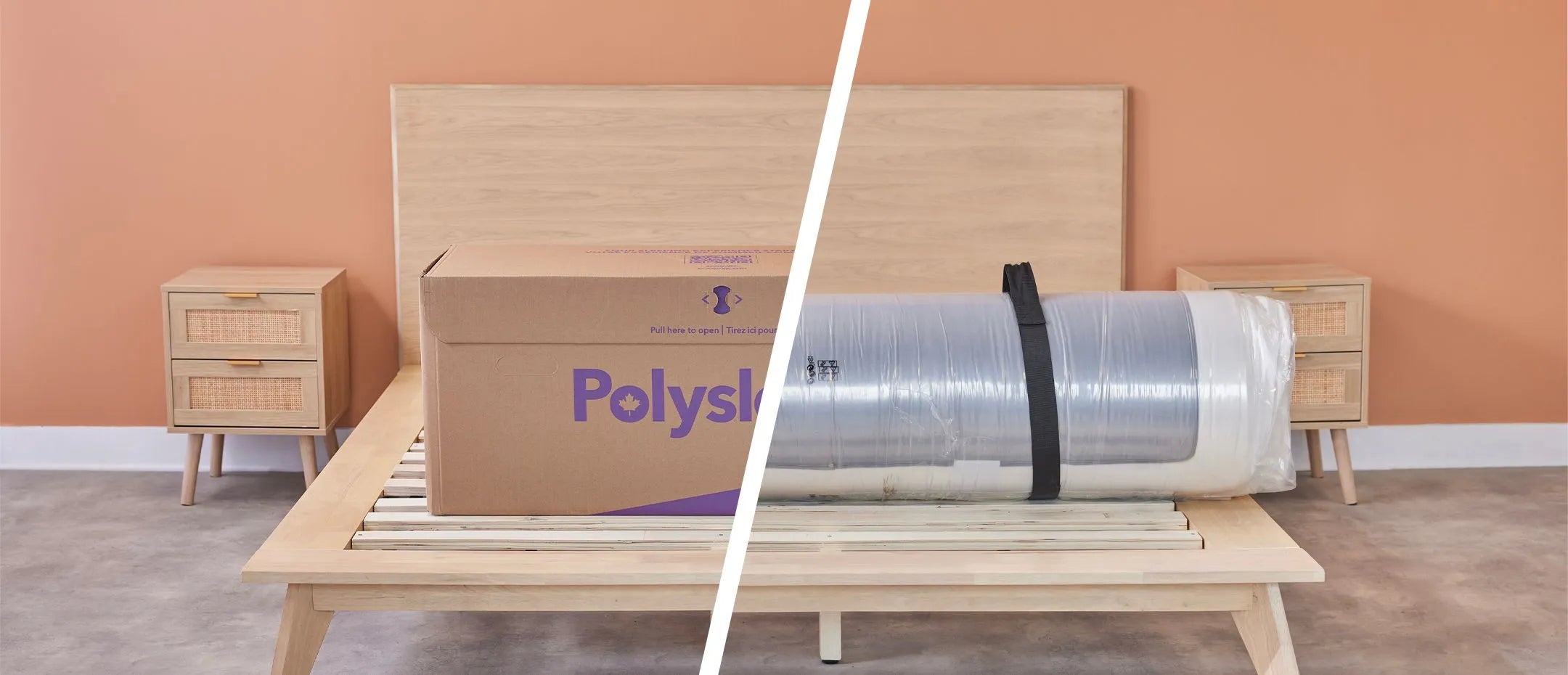
No. The Polysleep mattress unrolls and expands in the open air within minutes. No tools or outside help needed. It's designed to be easily handled by one person, even in a stairwell or narrow hallway.
Conclusion
The price difference between a mattress bought in a store and a DTC mattress does not reflect a difference in quality — it reflects a difference in economic model.
Polysleep is proof that you can get high-density, CertiPUR-US-certified foam made in Quebec at a fair price, because we sell directly to you with no middlemen.
And if you're not convinced, you have 100 nights to decide. Free return if you change your mind. No risk. Shop your Polysleep mattress in just a few clicks.
Find your ideal mattress and save an extra $50
Take the 60-second quiz, get a personalized recommendation based on your sleep and unlock an additional $50 off.